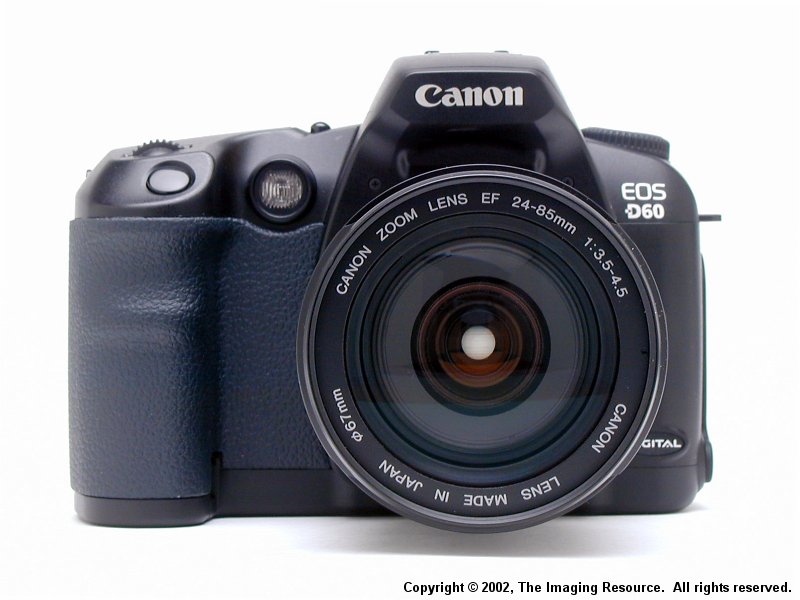
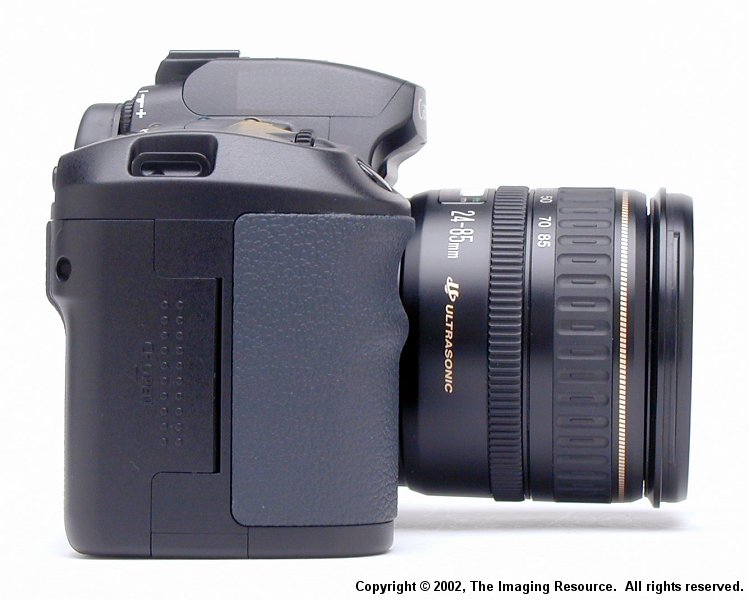
| Specification Highlights - full specifications here |
| Canon EOS D60 |
 |
| Imaging Sensor |
| Resolution: | Approx. 6.52 million total pixels (approximately 6.3 million effective pixels) |
| Recording pixels: | 3072 x 2048 |
| Sensor type: | CMOS sensor, with primary RGB filtration |
| Sensor size: | 22.7mm x 15.1mm; diagonal 27.3mm (same as EOS D30) |
| Lens focal length factor: | Approx. 1.6x |
| Pixel size: | 7.4 microns square |
| Performance |
| Maximum frames per second: | max 3 fps (at full resolution) |
| Maximum number of frames in a burst: | 8 (New: viewfinder display shows frames remaining in a burst) |
| Shutter speeds: | 30 seconds ~ 1/4,000, plus Bulb (choice of 1/2- or 1/3-stop increments) |
| Flash sync speed: | Up to 1/200, with built-in flash and EX-series Speedlites |
| Shutter "lag" time: | Approx. 100ms, from half-way point of shutter button's travel to fully depressed |
| Mirror "black-out" time: | Approx. 300ms, at 1/60 and faster shutter speeds |
| Computer interface: | USB v. 1.1 |
| Image Recording |
| Storage media: | CompactFlash cards, Type I and Type II (including Microdrives); single card slot |
| Image format options: | - RAW (.CRW-based RAW file, similar to EOS D30)
- JPEG (two levels: "Fine" and "Normal")
|
| Simultaneous RAW + JPEG recording: | RAW file incorporates 2.8 million pixel JPEG file; can be extracted with D60 driver software |
| Reduced resolution options: | "Middle" resolution (2048 x 1360 pixels; approx. 2.8 million pixel file)
"Small" resolution (1536 x 1024 pixels; approx. 1.6 million pixel file) |
| Data recording format: | DCF (Design rule for Camera File system); EXIF 2.2 compliant |
| User-set image Parameters: | Contrast, Sharpness, Color Saturation, and Color Tone can be adjusted in 3 steps by user |
| Folders: | Created automatically on CF card by camera within "DCIM" folder; cannot be user-set |
| Sound recording: | none |
| Image Playback |
| LCD Monitor: | 1.8-inch (diagonal) TFT color; approx. 100% coverage; approx. 114,000 pixels (improved visibility and shadow detail vs. D30) |
| Image playback: | Automatic after image is taken, or by pressing "Display" button on rear of body |
| Playback options: | - Single image with information and histogram
- Single image
- 9 images at a time
- Magnified view of single image
|
| Moving from shot to shot: | Turn Quick Control Dial |
| Information displayed: | 15 items on LCD monitor, including Histogram, when in "Single (Info)" playback mode |
| Highlight alert: | Possible (flashes over-exposed areas on and off to warn of error) |
| Menu structure: | 23 Menu items (grouped as Shooting items, Playback items, and Set-up items) |
| Autofocus |
| Number of AF points: | 3 (similar to EOS D30) |
| AF point illumination: | Red superimposed illumination (similar to EOS-1D); cancellable with C.Fn 14-1 |
| Focus modes: | One-Shot AF (for stationary subjects) and AI Servo AF (for tracking moving subjects) |
| Focusing speed and performance: | Same as EOS D30 |
| Methods of selecting AF point: | - Manual AF point selection
- Automatic AF point selection
(Eye-controlled AF point selection not possible) |
| AF working range: | EV 0.5 ~ 18 (1.5 stops greater low-light AF sensitivity than D30) |
| White Balance |
| Modes available: | - Auto
- User-set (Daylight, Overcast, Tungsten, Fluorescent, Flash)
- Custom (reading off gray card, or neutral white object)
|
| Exposure Control |
| ISO sensitivity: | 100, 200, 400, 800, 1000 |
| Exposure modes: | Program AE, Shutter-priority, Aperture-priority, Manual, Depth-of-field AE, Bulb |
| Metering: | 35-zone metering sensor (similar to EOS D30)- 35-zone Evaluative metering (improved algorithm vs. D30)
- Center-weighted metering
- Partial metering (central five metering zones; approx. 9.5% of picture area)
|
| Exposure compensation: | Possible in any Auto exposure mode, by turning rear Quick Control Dial; +/- up to 2 stops |
| Automatic Bracketing: | Possible in any mode, including Manual; 3 shots at up to +/- 2 stops exposure variation- Conventional bracketing of shutter speed and/or aperture (depends upon exposure mode)
|
| Flash |
| Compatible flashes: | - Canon EX-series Speedlites (Manual flash only with 540EZ, 430EZ, and 420EZ flashes)
- Non-dedicated, third-party shoe-mount flashes
- Studio strobes, via PC socket on camera body
|
| E-TTL flash metering: | 35-zone Evaluative flash metering, Through The Lens, with any EX-series Speedlite |
| Flash Exposure Lock: | 9.5% Partial reading of flash with any EX-series Speedlite (via AEL button on D60 body) |
| Flash Exposure Compensation: | +/- up to 2 stops; can be set on EOS D60 body, or on certain EX-series Speedlites (New: viewfinder icon indicates flash exposure compensation in effect) |
| Ambient exposure +/- w/ flash: | Possible by turning Quick Control Dial; does not affect E-TTL flash output |
| Flash Exposure Bracketing: | Possible with Speedlite 550EX, Macro Ring Lite MR-14EX, and Macro Twin Lite MT-24EX |
| Flash Metered Manual: | Not possible |
| Hi-speed flash sync: | Possible with EX-series Speedlites to 1/4,000; normal x-sync speed is 1/200 |
| Wireless E-TTL flash: | Fully compatible; ratio control (A:B or A:B:C) possible over six-stop range- Compatible "Master" units: 550EX, MR-14EX, MT-24EX; ST-E2 Transmitter (A:B only)
- Compatible "Slave" units: 550EX, 420EX
|
| PC socket: | Threaded socket on camera body for studio strobes |
| The Viewfinder |
| Viewfinder: | 95% coverage (magnification 0.88x, with 50mm lens at infinity, -1 diopter) |
| Viewfinder display: | Similar to EOS D30, with added new information:- Digital display of frames remaining in a burst
- Shots remaining on CF card (displayed when capacity limited to 8 or fewer images)
- Flash Exposure Compensation icon
|
| Focusing screens: | New Laser Matte screen; non-interchangeable (New: improved manual focus contrast) |
| Diopter: | Adjustable diopter (range -3.0 ~ +1.0); Dioptric Lens E can be added to extend range |
| Eyepiece blind: | none |
| The Camera Body |
| Chassis material: | Glass-fiber reinforced polycarbonate and Stainless Steel (similar to EOS D30) |
| Outer body material: | Polycarbonate resin |
| Operating temperature range: | Guaranteed 32*F ~ 104*F (0*C ~ 40*C); according to tests performed by Canon, Inc. |
| Dimensions (W x H x D): | 5.9 x 4.2 x 3.0 inches (149.5 x 106.5 x 75mm)
(world�s smallest 6-million pixel digital SLR with interchangeable lenses) |
| Weight (without battery or CF card): | 27.5 oz. (780g) |
| Power Supply |
| Battery: | Rechargeable Canon BP-511 (Lithium Ion; same battery as EOS D30) |
| Battery supplied with camera (in USA): | Body only�no battery included; D60 "Kit"�includes battery, charger, & AC adapter |
| Battery capacity: | - 620 shots, without built-in flash, at 68*F (20*C)
- 400 shots, with 50% taken with built-in flash (same temperature)
|
| Expanded Battery capacity: | Optional Battery Grip BG-ED3 accepts two BP-511 batteries (same accessory battery grip as used on EOS D30) |
| Battery check: | Full-time, 3-stage display on top LCD panel (appears whenever camera is ON) |
| Recharging battery: | Compact Power Adapter CA-PS400 (supplied with camera) charges up to two batteries |
| Recharging time: | Approx. 90 minutes for fully exhausted BP-511 battery pack |
| AC power option: | DC Coupler DR-4 (supplied with EOS D60 camera kit, not body only)- Voltage range 100v ~ 240v
- Consists of "dummy" battery with cord, which plugs into charger unit
|
| Customization |
| Custom Functions: | 14 Custom Functions built into camera; user-selectable via Menu on rear LCD panel (similar to EOS D30)- New: C.Fn 14�turn off illumination of AF points in viewfinder
- New: C.Fn 15�shutter release impossible without CF card in camera
- Custom Function 1 eliminated (long exposure noise reduction built into CMOS sensor)
|
| Note: | All specifications are preliminary and subject to change without notice. All information and specifications based on Canon, Inc.'s standard test methods, and are current as of December, 2001. |
| More Photos |
 |
 |
 |
 |
 |
 |
 |
 |
| |


 Canon announces update to the EOS D30!