Sony DSC-S85Sony extends its S-series Cybershot line with the S85, sporting a 4-megapixel CCD, Exposure Bracketing, and Burst 3 sequential capture.<<Operation & User Interface :(Previous) | (Next): Image Storage & Interface>> Page 9:Camera Modes & MenusReview First Posted: 6/7/2001 |
Camera Modes and Menus
 Program AE: Noted on the Mode dial with the green camera symbol, Program mode places the camera in control of both the aperture and shutter speed settings, allowing you to set the remaining exposure variables (White Balance, ISO, Exposure Compensation, Image Size, Picture Quality, Flash, and Normal or Spot Metering).
 Shutter Priority: In Shutter Priority mode, you set the shutter speed (from 1/1,000 to eight seconds), while the camera selects the best corresponding aperture. All other exposure variables can also be adjusted.
 Aperture Priority: In Aperture Priority mode, you set the desired lens aperture (from f/2.1 to f/8.0) while the camera selects the best corresponding shutter speed. All other exposure variables can also be adjusted.
 Manual: Manual exposure mode offers full user control over exposure, including aperture and shutter speed settings. All exposure variables except for exposure compensation are available in this mode.
 Scene: Scene mode provides access to three preset shooting modes: Twilight, Landscape, and Portrait. The actual scenes are changed through the Setup menu (in Setup mode). Twilight mode uses a slow shutter speed to accommodate darker shooting situations. If used with a flash, this becomes a slow sync mode, capturing the illuminated subjects in the foreground with the flash, and using the longer shutter speed to record ambient light from the background. Landscape mode uses a small aperture opening to keep both the foreground and background in focus. The Portrait mode uses a large aperture opening to decrease the depth of field, thereby keeping the subject in sharp focus and slightly blurring the background. Most exposure variables, except for aperture and shutter speed settings, are available in the Scene modes.
 Setup: Setup mode lets you change basic camera settings.
 Movie: Movie mode, marked on the Mode dial with a film strip symbol, captures MPEG movies up to 60 seconds with sound. Most exposure variables are available, except for flash and ISO. If the Clip Motion option is selected from the Setup menu, Movie mode will capture up to 10 frames of still GIF images at a time, to be played back in succession to create an animated effect.
  Playback: Captured images and movies can be reviewed and played back in this mode. Images can also be erased, write-protected, copied, resized, set up for printing on a DPOF device, or played back in a slide show. A rudimentary editing function (Divide) allows you to chop up movie files into smaller segments.
Record Menu: The Record menu is accessible in all capture modes by pressing the Menu button, however, not all menu options are available in all capture modes.
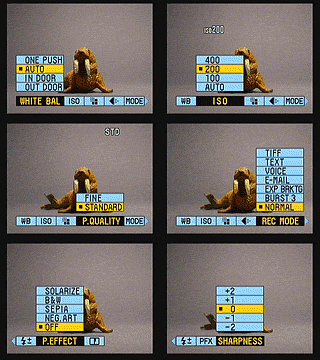 White Balance: Adjusts the camera's white balance to accommodate a variety of light sources. Options include: One Push (manual setting), Auto, Indoor, and Outdoor.
- ISO: Changes the camera's light sensitivity level. Choices are Auto, 100, 200, and 400 ISO equivalents.
- Image Size: Sets the image resolution to 2,272 x 1,704, 2,272 x 1,567 (3:2), 1,600 x 1,200, 1,280 x 960, or 640 x 480 pixels for still images. Movie file sizes are 320 (HQ), 320 x 240, and 160 x 112. Clip Motion file sizes are Normal (160 x 120 pixels) or Mobile (80 x 72 pixels).
- Quality: Sets the JPEG compression level to Fine or Standard.
- Record Mode: Accesses the following recording modes:
- TIFF: Records images in the uncompressed TIFF file format (at the 2,272 x 1,704 pixel size, in addition to another image at the pixel resolution and JPEG compression levels set under Image Size and Quality submenus).
- Text: Captures black-and-white images of text on black board or white board background. Images are saved in GIF format.
- Voice: Records up to 40-second sound clips to accompany captured images.
- E-Mail: Captures an additional image file at 320 x 240 pixels for easy e-mail transmission.
- Exposure Bracketing: Records the same image at three different exposures: one normal, one overexposed, and one underexposed.
- Burst 3: Allows the camera to record a maximum of three frames in rapid succession. Actual frame rates vary with file size and the amount of image information being recorded.
- Normal: Returns the camera to normal still capture mode.
- Flash Level: Assigns the flash intensity level to High, Normal, or Low.
- Picture Effects: Activates a variety of creative picture effects modes, including Solarize, Black and White, Sepia, and Negative Art. The Off setting returns the camera to normal capture mode.
- Sharpness: Adjusts the image sharpness from -2 to +2 in five available settings (zero is the normal sharpness level).
Setup Menu: The three-panel setup menu is automatically displayed on the LCD monitor upon entering Setup mode:
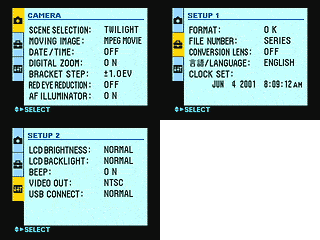 Scene Selection: Specifies which Scene mode is activated when the mode dial is in the Scene position. Options are Landscape, Twilight, and Portrait.
- Moving Image: Establishes the Recording mode to be used when the mode dial is set to the Movie position: MPEG Movie or Clip Motion.
- Date / Time: Determines whether or not the date and/or time is recorded with the image. Choices are Off, Date, and Day & Time.
- Digital Zoom: Turns the 2x digital telephoto function on or off.
- Bracket Step: Sets the Exposure Bracketing to +/- 1.0 EV, 0.7 EV, or 0.3 EV steps
- Red-Eye Reduction: Enables or disables the Red-Eye Reduction flash mode.
- AF Illuminator: Turns the AF Illuminator lamp on the front of the camera on or off.
- Format: Formats the Memory Stick, erasing all images.
- File Number: Determines the file numbering sequence. Reset changes the file numbering with each new Memory Stick inserted into the memory card slot. Series continues file numbering from one Memory Stick to the next.
- Conversion: Turns the lens conversion function on, which allows the camera to focus with an accessory lens kit.
- Language: Sets the menu language to English or Japanese.
- Clock Set: Sets the camera's internal clock and calendar.
- LCD Brightness: Adjusts the LCD's brightness level (really more of a contrast adjustment) to Bright, Normal, or Dark.
- Beep: Controls the camera's operating sounds. Choices are Shutter (shutter sound only), On (activates all camera sounds), and Off (silences the camera).
- Video Out: Sets the A/V Out signal to NTSC or PAL timing.
- USB Connect: Establishes the type of USB connection: Normal or PTP. (PTP is a new connection option, supposedly requiring no host driver software. We're awaiting further info from Sony before we can test this.)
- Demo: Activates or deactivates the Demo program when the camera is left on Standby with the AC power adapter. Choices are On and Off. (Only visible when the camera is running off the AC Adapter.)
Playback Menu: As with the Record menu, the Playback menu is accessed by pressing the Menu button when in Playback mode. The following options are available:
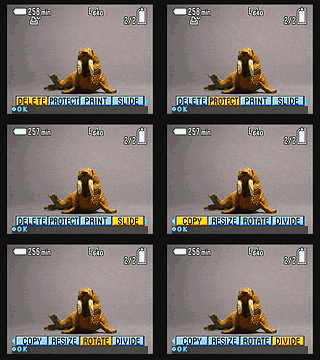 Delete: Deletes the current image, with an option to cancel.
- Protect: Write-protects the currently displayed image from accidental erasure or manipulation in any way (except for card formatting, which deletes all images).
- Print: Marks the current image for printing on a Digital Print Order Format (DPOF) compatible device.
- Slide: Activates an automatic slide show of all images on the card. You can define the picture interval and whether or not the slide show repeats itself.
- Copy: Copies the current image onto another Memory Stick.
- Resize: Resizes the currently displayed image to 2,272 x 1,704, 1,600 x 1,200, 1,280 x 960, or 640 x 480 pixels.
- Rotate: Rotates the displayed image 90 degrees clockwise or counterclockwise.
- Divide: Activates the in-camera movie editing process, which "divides" a single movie into two, three, or more pieces.


Follow Imaging Resource: